
Contents
- 1. How to Choose the Right Meat Grinder for Pet Food Production
- 2. 1. Match the Machine with Your Raw Material Types
- 3. 2. Confirm Processing Capacity to Match Production Scale
- 4. 3. Focus on Particle Uniformity and Adjustable Fineness
- 5. 4. Prioritize Food-Grade Material and Sanitary Design
- 6. 5. Check Stable Performance and Safety Protection
- 7. 6. Consider Multi-Function and Expandability
- 8. 7. Factory Certification and After-Sales Support
- 9. Final Conclusion
- 10. FAQ
How to Choose the Right Meat Grinder for Pet Food Production
Pet food production has extremely strict requirements for raw material fineness, hygiene standards, and processing stability. Choosing a qualified meat grinder for pet food production is one of the most critical steps for pet food factory quality control.
Unlike ordinary meat grinders for human food, professional grinders designed for pet food need to handle frozen meat, meat bones, fish meat, and mixed vegetable ingredients stably. They must maintain uniform particle size and high sanitary safety during operation.
Choosing the right commercial meat grinder for pet food production directly improves product quality, reduces production loss, and lowers long-term operating costs. This guide covers all key factors to help you select the most suitable machine for your pet food processing plant.
1. Match the Machine with Your Raw Material Types
Pet food formulas usually combine fresh meat, frozen meat, chicken frames, fish, and vegetables. These mixed raw materials place higher demands on grinding equipment.
Ordinary household or light-duty grinders easily get stuck, overheat, or produce uneven particles when processing hard frozen materials. They cannot meet continuous industrial production standards for pet food.
For professional pet food production, choose an industrial frozen meat grinder that supports direct grinding of -18°C frozen meat without thawing. It greatly improves production efficiency and retains raw material nutrition.
The reinforced auger structure and high-hardness cutting blades ensure stable cutting performance for tough raw materials. They effectively avoid material extrusion damage and grease separation.
If your formula contains potato, carrot, or vegetable puree ingredients, a multi-functional grinder that supports both meat and vegetable grinding is the most cost-effective choice.
2. Confirm Processing Capacity to Match Production Scale
Production capacity is one of the core indicators for model selection. You need to match machine output with your actual production scale.
Small workshops and central kitchens usually need 300–500kg/h output. Medium and large pet food factories require 800–1000kg/h continuous processing capacity for mass production.
Choosing a machine with matched hourly output avoids equipment overload or capacity waste. It keeps your production line running stably and efficiently.
Standardized models such as JR-100, JR-200, and JR-300 cover the full range of small to large pet food production demands. They deliver reliable continuous working performance for batch processing.
3. Focus on Particle Uniformity and Adjustable Fineness
Pet food texture directly affects pet appetite and final product sales. High-quality pet food requires consistent particle size without large chunks or excessive fine paste.
Ununiform grinding results in unstable product taste, which will easily cause customer complaints and brand reputation loss.
A qualified commercial pet food grinder is equipped withmultiple interchangeable grinding plates to adjust coarse, medium, and fine output freely.
It can produce uniform meat granules for dry pet food and delicate meat puree for wet pet food and pet snacks.
Self-sharpening blade technology ensures long-term consistent cutting effect. It avoids particle deviation caused by blade wear during long-hour operation.
4. Prioritize Food-Grade Material and Sanitary Design
Food safety is the bottom line of pet food factory certification. All material contact parts of the grinder must adopt full SUS304 food-grade stainless steel.
This material is rust-proof and corrosion-resistant, fully compliant with EU food hygiene and FDA food contact surface standards, ensuring safe pet food production.
The integrated seamless curved design effectively avoids material residue and bacterial growth, solving common hygiene dead-end problems.
The quick-disassembly structure allows thorough and fast cleaning. It meets daily high-standard sanitation requirements and helps factories pass official inspections and certifications smoothly.
5. Check Stable Performance and Safety Protection
Long-term continuous production requires equipment with stable mechanical performance and complete safety mechanisms.
Professional pet food processing grinders are equipped with overload protection, stall protection, and emergency stop devices. These functions effectively prevent motor burnout and mechanical failure caused by excessive materials.
The forward and reverse rotation function solves material jamming problems efficiently, reducing manual operation difficulty and improving production efficiency.
Equipped with a full copper motor and reinforced mechanical gear, the machine runs with low noise and low failure rate, supporting 24-hour batch production and long service life.
6. Consider Multi-Function and Expandability
Modern pet food production adopts diversified formulas with mixed ingredients. A multi-functional meat grinder supports processing various meats, potatoes, pumpkins, carrots and other vegetables.
It realizes one machine for multiple purposes, greatly saving additional equipment investment costs for pet food factories.
For factories with future expansion plans, standardized series grinders reserve reserved interfaces for production line docking.
It is convenient for later upgrading to automated integrated pet food production lines, improving overall factory automation level.
7. Factory Certification and After-Sales Support
When purchasing industrial meat grinders for pet food production, prioritize manufacturers with complete CE, ISO, and factory qualification certificates.
Fully certified equipment can smoothly pass customer factory audits and export customs clearance, effectively avoiding export risks.
Reliable after-sales service, long-term spare parts supply and professional technical support ensure stable production line operation.
These services are essential foundations for long-term and stable cooperation with pet food processing enterprises.
Final Conclusion
The ideal meat grinder for pet food production features stable frozen meat processing capacity and adjustable particle fineness.
It also supports food-grade sanitary design and industrial-grade continuous working performance, fully matching professional pet food production standards.
By matching the raw material types, production capacity and functional requirements of your meat grinder for pet food production, you can avoid improper selection.
Scientific model selection effectively improves pet food product quality and overall production efficiency.
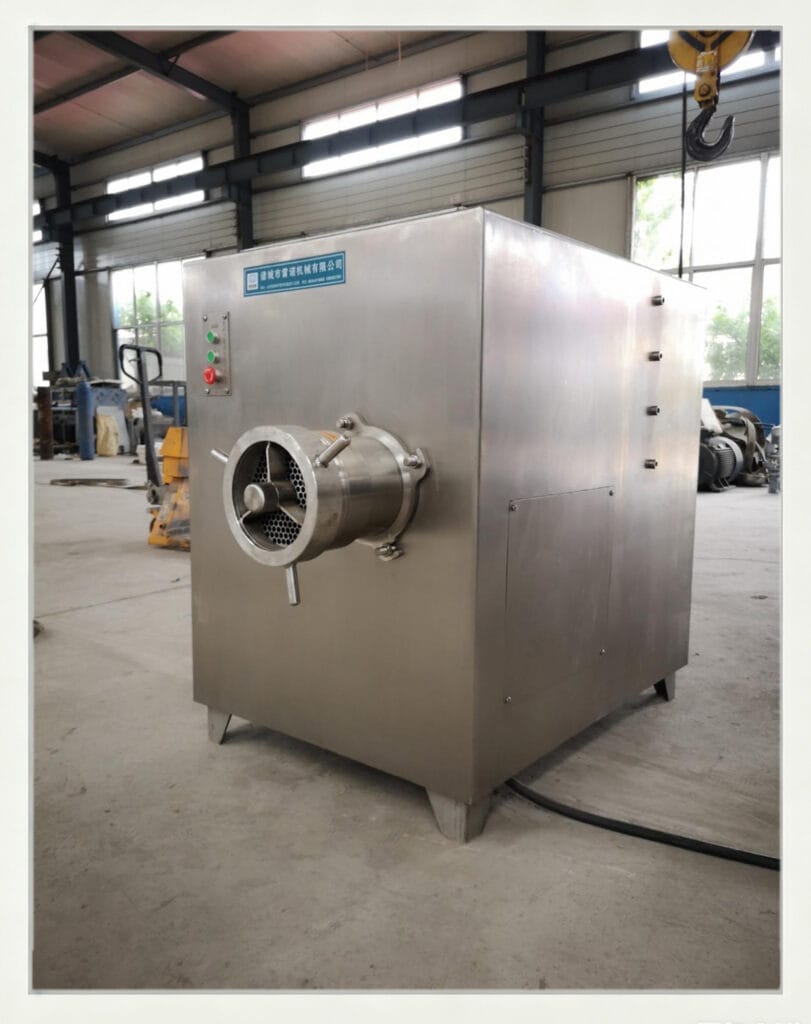
If you are looking for a professional commercial meat grinder for pet food processing, Longerfm is your reliable choice.
We provide full-series industrial grinders with complete certifications, real machine test support and customized production solutions for global pet food manufacturers.