
No-Thaw Frozen Bone Meat Processing Line Technical Guide
No-Thaw Frozen Bone Meat Processing Line Technical Guide
1. Introduction
The no-thaw frozen bone meat processing line is a newly upgraded automated integrated system tailored for large-scale deep processing of frozen livestock and poultry raw materials.
Different from conventional meat processing systems that rely on water soaking or natural thawing, this professional processing equipment supports direct production of raw materials at -5℃ to -22℃, completely eliminating traditional thawing procedures.
It effectively saves factory space, reduces water and power consumption, and avoids quality deterioration and flavor loss caused by long-time raw material thawing and exposure.
Featuring a high production capacity of 5000–8000kg/h and ultra-compact floor space of only 8 square meters, the no-thaw frozen bone meat processing line integrates feeding, crushing, emulsification, constant temperature stirring and pipeline conveying.
It is widely applicable to pet wet food manufacturing, quick-frozen prepared meat processing, bone sauce and bone soup production.
This technical guide elaborates on equipment structure, working principles, standardized operation procedures, parameter settings, daily maintenance and fault solutions to help factories achieve stable, hygienic and high-efficiency continuous production.
Contents
2. Full Line Composition & Working Principle
2.1 Standard Line Configuration
This no-thaw frozen bone meat processing line adopts a modular assembled structure, realizing one-stop automated processing without manual intermediate transfer.
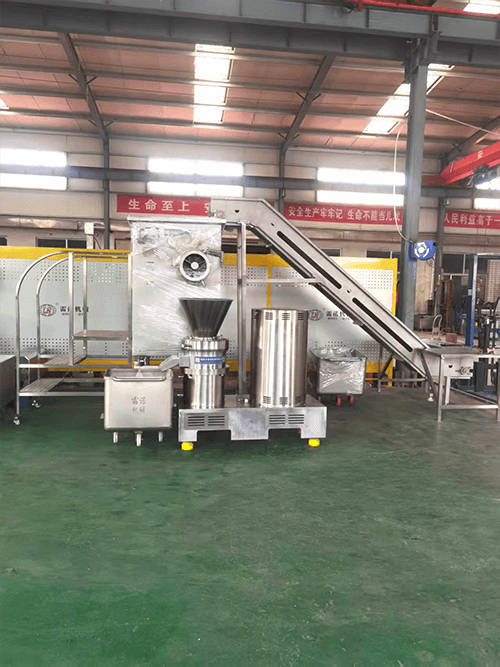
The standard complete set of equipment includes an unpacking table, TS-4500 material elevator, JR series industrial meat grinder, GN series ultra-fine bone mud mill, constant temperature heating mixing tank and supporting transfer pump.
Every single equipment unit is matched with precise operating speed and conveying capacity, ensuring seamless connection and non-stop continuous operation of the entire production line.
2.2 Working Principle
The no-thaw frozen bone meat processing line adopts closed graded crushing and emulsification technology to process frozen raw materials in one go. After unpacking, whole-box frozen bone meat and frozen meat blocks are stably transported to the meat grinder via the elevator for primary coarse crushing, turning massive frozen raw materials into uniform small particles.
The crushed bone and meat particles are automatically pumped into the bone mud mill for secondary ultra-fine grinding and emulsification to form delicate and smooth bone-meat puree.
Subsequently, the fine puree enters the constant temperature mixing tank for heat preservation and uniform blending to prevent solidification.
Finally, the qualified raw material puree is stably output by the transfer pump for subsequent filling, forming and canning procedures. The whole processing flow needs no pre-thawing, and fully enclosed conveying greatly reduces manual contact, locking the original nutrition and fresh taste of raw materials and improving finished product yield.
3. Core Technical Parameters & Performance Advantages
3.1 Key Technical Specifications
- Maximum Processing Capacity: 5000–8000kg/h
- Total Installed Power: 152kw
- Applicable Raw Material Temperature: -5℃ ~ -22℃ (full frozen direct processing)
- Equipment Floor Space: Approximately 8 square meters
- Production Material Standard: Full food-grade SUS304 stainless steel
- Required Operators: Only 2 workers for full-line operation
3.2 Core Technical Advantages
Innovative No-Thaw Direct Processing
The core innovation of this no-thaw frozen bone meat processing line is canceling the traditional thawing process.
It can directly process ultra-low-temperature frozen bone meat raw materials, saving the construction cost of thawing workshops and pools, cutting water and electricity waste, and avoiding raw material oxidation and deterioration during thawing.
Fully Automatic Closed-Loop Production
The no-thaw frozen bone meat processing line realizes full-process automated operation from feeding to discharging.
The fully enclosed pipeline conveying mode avoids secondary pollution caused by manual turnover, strictly conforms to international food hygiene standards, and supports standardized batch production.
Dual Production Mode Switchable Freely
With flexible modular equipment combination, the no-thaw frozen bone meat processing line adapts to two mainstream production modes: traditional prepared meat product processing and pet wet food deep processing.
Factories can adjust equipment collocation according to different product formulas and production processes.
Constant Temperature Anti-Blockage System
Equipped with a professional heating and heat preservation mixing tank, the no-thaw frozen bone meat processing line keeps bone-meat puree at a constant temperature during processing and conveying. It effectively prevents material solidification, ensures unobstructed pipeline circulation, and improves the stability of long-term continuous production.
Full Hygienic Detachable Structure
All material contact parts and conveying pipelines of the no-thaw frozen bone meat processing line adopt SUS304 stainless steel detachable design.
There are no sanitary dead corners hiding residual materials, supporting quick disassembly and high-pressure water cleaning to meet strict food factory audit and export hygiene requirements.
4. Standard Operation Workflow (SOP)
4.1 Pre-Production Inspection
Before starting the no-thaw frozen bone meat processing line, inspect all connecting pipelines, fasteners and sealing components to ensure firm installation and no damage.
Check the wear condition of meat grinder blades and bone mill rotor and stator parts. Test the heating system and material pumping system to guarantee normal startup operation. Thoroughly clean the equipment surface and inner cavity to remove residual materials from the last production batch.
4.2 Startup Sequence
Follow the standard startup sequence: heating mixing tank and transfer pump → bone mud mill → meat grinder → material elevator → feeding platform. Preheat the mixing tank to the process temperature required by the product, and run the no-thaw frozen bone meat processing line idly for 3 to 5 minutes to check for abnormal vibration, noise and pipeline leakage.
4.3 Formal Feeding & Production
Sort and unpack whole-box frozen bone meat raw materials and place them on the feeding platform for uniform conveying and processing. Avoid instantaneous excessive feeding to prevent equipment blockage. Real-time observe the fineness and uniformity of discharged bone-meat puree to ensure full emulsification without granular residues.
4.4 Shutdown & Cleaning Procedure
Stop feeding first, and keep the no-thaw frozen bone meat processing line idling for 5–10 minutes to completely discharge residual materials in the pipeline. Shut down the equipment in reverse startup order.
Disassemble the grinding head, mill cavity and connecting pipelines for comprehensive flushing. Dry all disassembled parts and reset them for standby to prevent bacterial growth caused by residual material fermentation.
5. Applicable Process Scenarios & Model Selection
5.1 Suitable Production Scenarios
Pet Wet Food Canning Factories: The no-thaw frozen bone meat processing line completes integrated crushing and ultra-fine emulsification of frozen chicken frames, frozen bone residues and bone-meat mixtures, producing delicate bone paste for canned pet wet food and meat snacks.
Quick-Frozen Prepared Food Enterprises: It provides high-quality preprocessed meat paste raw materials for quick-frozen meatballs, sausages, luncheon meat and various commercial prepared meat products, ensuring stable product taste and texture.
Bone Soup & Seasoning Manufacturing Plants: This no-thaw frozen bone meat processing line realizes one-step coarse crushing and fine grinding of frozen livestock and poultry bones, supporting mass production of bone soup concentrate, bone mud sauce and flavor seasonings.
5.2 Model Matching Suggestions
For medium and small batch production, match JR-200/JR-250 meat grinder with GN-180 bone mud mill to stabilize 5000–6000kg/h output.
For large-scale industrial mass production, select JR-300 grinder and GN-240/GN-300 bone mud mill to support 7000–8000kg/h high-efficiency output, fully adapting to 24-hour uninterrupted operation of the no-thaw frozen bone meat processing line.
6. Daily Maintenance & Hygiene Management
Daily Maintenance: Check the tightness of transmission components and the wear degree of grinding accessories of the no-thaw frozen bone meat processing line every day. Regularly supplement lubricating oil for transmission parts to ensure stable operation. Clean pipeline filters to avoid blockage caused by accumulated fine bone residues.
Weekly Maintenance: Completely disassemble and clean all equipment cavities and pipelines of the no-thaw frozen bone meat processing line. Inspect rotor and stator gaps, calibrate operating speed and constant temperature parameters, and eliminate potential equipment faults in advance.
Monthly Maintenance: Conduct comprehensive inspection of the whole line’s circuit system, motors and pumping equipment. Replace severely worn vulnerable parts to ensure long-term stable operation of the no-thaw frozen bone meat processing line.
Hygiene Standard: All food-contact parts comply with FDA and CE food-grade safety standards. The dead-corner-free detachable design of the no-thaw frozen bone meat processing line ensures zero residual materials after cleaning, fully meeting international food export(HACCP) and factory hygiene audit standards.
7. Common Faults & Troubleshooting
- Material Blockage: Caused by excessive instantaneous feeding or ultra-hard frozen raw materials. Solution: Stop feeding immediately, run the line idly to discharge residual materials, control uniform feeding speed, and avoid processing raw materials below -22℃ to protect the no-thaw frozen bone meat processing line.
- Uneven Puree Fineness: Caused by worn grinding teeth and abnormal rotor-stator gaps. Solution: Replace vulnerable accessories and recalibrate equipment gaps to restore the uniform emulsification effect of the processing line.
- Pipeline Solidification & Poor Discharging: Caused by low temperature of the heating tank. Solution: Preheat the equipment in advance, adjust constant temperature parameters, and keep pipeline circulating during production intervals to prevent material solidification.
- Abnormal Vibration & Noise: Caused by loose fasteners or foreign hard objects in the cavity. Solution: Power off the equipment for inspection, remove foreign matters, and fasten all fixed parts to ensure stable operation.
8. Conclusion
The no-thaw frozen bone meat processing line is an efficient and energy-saving upgraded solution for modern meat deep processing industries. It solves multiple industry pain points of traditional processing lines, including high energy consumption, large floor space, heavy manual labor and unstable product quality.
Scientific standardized operation and regular professional maintenance can maximize the production efficiency of the no-thaw frozen bone meat processing line, stabilize finished product quality, and create long-term economic benefits for food and pet food processing enterprises.