
Freeze-Dried Pet Food Production Line: Complete Investment Guide for 2026
Freeze-Dried Pet Food Production Line: Complete Investment Guide for 2026
Introduction
The global market for pet food freeze-drying equipment was estimated at US$156 million in 2025 and is projected to reach US$289 million by 2032, growing at a CAGR of 8.8%. Meanwhile, the downstream freeze-dried pet food market is expanding even faster — from US$16.77 billion in 2026 to a projected US$26.77 billion by 2031, a CAGR of 9.8%.
This dual growth dynamic — equipment demand rising alongside finished product demand — creates a compelling investment case for manufacturers considering entering the freeze-dried pet food space.
However, scaling from small-batch production to commercial operations requires more than purchasing a freeze dryer. It demands a complete production line: raw material preparation, pre-freezing, vacuum freeze-drying, post-processing, and packaging. This guide walks through every stage, with real cost data and practical planning advice.
Why Freeze-Dried Pet Food? The Business Case
Freeze-drying (lyophilization) removes moisture from frozen raw ingredients through sublimation under vacuum, preserving the original shape, flavor, and nutritional characteristics of the feed material. The resulting product is shelf-stable without refrigeration — a critical advantage for e-commerce distribution and retail channels.
Key market drivers include:
Pet humanization: Owners increasingly seek raw-style nutrition without the handling complexity of frozen food.
Premium positioning: Freeze-dried products command significantly higher retail prices than conventional treats or kibble.
E-commerce compatibility: Lightweight, shelf-stable products are ideal for direct-to-consumer shipping.
Functional formulation: Freeze-drying preserves probiotics, enzymes, and other heat-sensitive functional ingredients that cannot survive extrusion or baking.
The Complete Freeze-Dried Pet Food Production Process
The production process can be divided into six stages:
Stage 1: Raw Material Preparation
Fresh or frozen meat is ground to the desired particle size. For complete diets, ingredients are blended into a uniform slurry. The material may undergo high-pressure processing (HPP) as a pre-freeze-dry kill step to reduce microbial load before freezing.
Stage 2: Forming & Portioning
The prepared mixture is shaped into uniform pieces — nuggets, patties, nibs, or toppers — depending on the target product format. Consistent piece size is critical for uniform freeze-drying.
Stage 3: Pre-Freezing
Formed pieces are rapidly frozen to below -40°C using an IQF (individually quick frozen) tunnel or blast freezer. Rapid freezing creates small ice crystals that preserve cell structure and enable efficient sublimation during the drying phase. The material must be frozen to below its triple point before vacuum is applied.
Stage 4: Vacuum Freeze-Drying (Primary Drying)
Frozen trays are loaded into the vacuum chamber. Under reduced pressure, ice sublimes directly into vapor without passing through a liquid phase. This primary drying stage removes approximately 95% of the moisture. Chamber pressure is typically maintained between 0.1 and 0.5 mbar, with shelf temperatures carefully controlled to provide the latent heat of sublimation without melting the product.
Stage 5: Desorption (Secondary Drying)
After sublimation, a secondary drying phase uses slightly elevated temperatures and lower pressure to remove bound moisture, bringing the final moisture content to 2–5%. Water activity — not simply moisture content — is the industry standard for determining shelf stability, as pathogens cannot grow below certain water activity thresholds.
Stage 6: Post-Processing & Packaging
Finished product exits the chamber and is inspected, sorted, and packaged. Barrier packaging (oxygen and moisture barrier films) with optional nitrogen flushing maintains product quality over the shelf life.
Equipment Configuration by Production Scale
| Scale | Freeze Dryer Capacity | Key Specifications | Typical Investment |
|---|---|---|---|
| Tabletop / R&D | 5–20 kg/batch | Single chamber, manual loading | $3,000–$5,000 |
| Small Commercial | 50–100 kg/batch | 10 m² shelf area, automatic control | $75,000–$150,000 |
| Mid Commercial | 200–500 kg/batch | Modular chambers, CIP, automated tray handling | $200,000–$500,000 |
| Industrial | 700–1,600+ kg/batch | Multiple chambers, full automation, SCADA | $500,000–$1,000,000+ |
Large-capacity systems can handle 700 kg, 1,350 kg, 1,600 kg, or even 2,800–3,200 kg per batch, depending on chamber configuration.
The Hidden Costs: What Buyers Often Overlook
Industry experts consistently warn that the freeze dryer itself is only part of the investment. “It’s critical to understand that it’s not only an investment in the dryer, but there’s a significant amount of ancillary requirements to get production up and running,” notes Jerad Ducklow of Parker Freeze Dry.
Critical ancillary requirements include:
IQF tunnel or blast freezer for pre-freezing
Dicing, grinding, and forming equipment for raw material preparation
Tray handling systems — loading, unloading, and washing
Packaging systems — weighers, sealers, and barrier film
Facility infrastructure — the geographic footprint required for tray washing alone can be substantial. “We’re getting ready to wash thousands of pans a day,” Jones observed.
Utilities — industrial refrigeration, vacuum pumps, and process cooling
A realistic budget for a mid-scale commercial freeze-dried pet food line (200–500 kg/batch) should account for 30–50% additional investment beyond the freeze dryer itself.
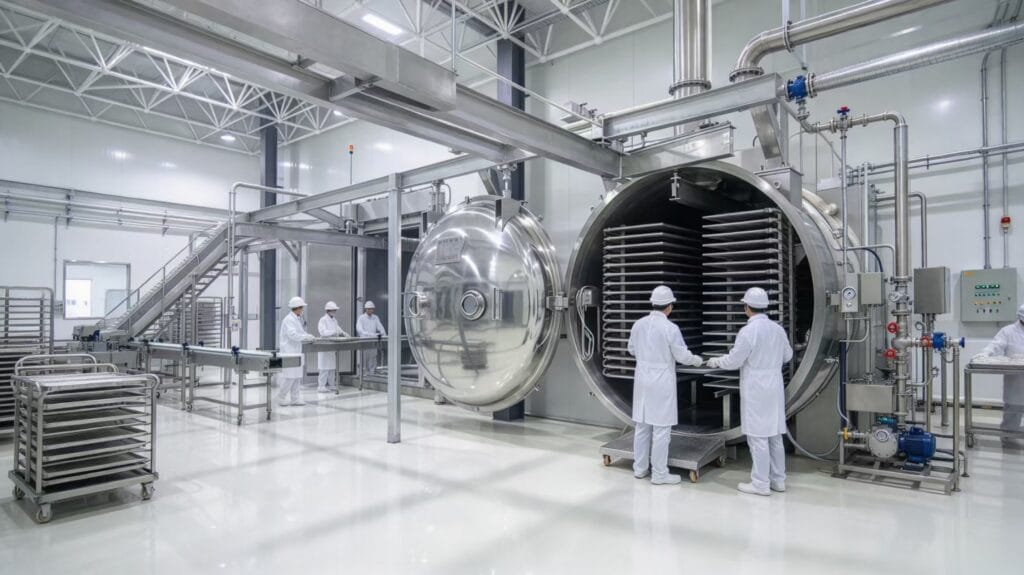
Food Safety in Freeze-Dried Pet Food Production line
Freeze-drying presents a unique food safety challenge: unlike extrusion, baking, or retort processing, the freeze-drying process does not rely on heat-based kill steps. This means microbial control must be addressed through:
Raw material sourcing — strict supplier verification and incoming material testing
Pre-treatment — HPP or other non-thermal kill steps before freezing
Water activity control — achieving and maintaining water activity levels below the pathogen growth threshold
Environmental monitoring — cleanroom-level controls in the post-drying and packaging zones
Finished product testing — routine microbiological testing of every batch
The shift from small, standalone machines to higher-capacity, hygienically designed and increasingly automated production systems is one of the defining equipment trends in this segment.
ROI Analysis: Is a Freeze-Dried Pet Food Production Line Worth the Investment?
The business case for freeze-dried pet food rests on three pillars:
High retail price point: Freeze-dried products retail at 3–10x the price per pound of conventional kibble.
Growing market: The freeze-dried pet food market is growing at 9.8% CAGR, with the Asia Pacific region registering the highest growth rate of 10.7%.
Production flexibility: The same freeze-drying platform can process whole-cut meat, minced formulations, complete meals, and liquid products, enabling product portfolio diversification without additional equipment investment.
For a mid-scale operation (300 kg/batch, two batches per day, 300 working days per year), the annual output capacity is approximately 180 tons. At a wholesale price of $30–$50/kg for finished freeze-dried product, annual revenue potential ranges from $5.4 million to $9 million — against a total equipment investment of $500,000–$800,000.
FAQ
Q: Can I start with a small freeze dryer and scale up later?
A: Yes, but plan for scalability from day one. Modular chamber designs allow capacity expansion without replacing the entire system. However, many producers find that starting too small creates operational bottlenecks within months — ensure your preparation, freezing, and packaging equipment can support future capacity increases.
Q: What is the typical freeze-drying cycle time?
A: Cycle time depends on product thickness, moisture content, and chamber load. Thin products (5–10 mm) may dry in 12–18 hours; thicker pieces (20–30 mm) can require 24–48 hours.
Q: How do I choose between batch and continuous freeze-drying systems?
A: Batch systems remain the mainstream configuration for pet food production. They offer flexibility across product types and are easier to validate for food safety. Continuous systems are better suited for very high-volume, single-product operations.
Conclusion
The freeze-dried pet food segment offers one of the strongest growth opportunities in the pet food industry. With the equipment market expanding at 8.8% annually and finished product demand growing even faster, investing in a complete freeze-dried production line positions manufacturers to capture premium market share.
Planning a freeze-dried pet food production line? Contact LongerFM for a detailed equipment configuration and investment analysis tailored to your target capacity and product format. From IQF pre-freezing through packaging, we provide integrated solutions for every stage of the process.
Related articles: