
Cat Stick Production Line: Complete Equipment Guide for Wet Pet Food Manufacturers
Contents
Cat Stick Production Line: Complete Equipment Guide for Wet Pet Food Manufacturers
Introduction
Cat sticks — also known as creamy cat treats, lickable treats, or squeeze-up cat snacks — have become one of the fastest-growing segments in the global pet food market. Unlike traditional canned or pouched wet food, cat sticks are semi-solid, paste-like treats packaged in narrow tubular sachets that owners squeeze directly for their cats to lick. The format is convenient, mess-free, and highly palatable — three characteristics that drive repeat purchase behavior.
For manufacturers, the cat stick format presents a specific set of production challenges. The product must be smooth enough to extrude through a narrow nozzle, stable enough to hold its shape in the sachet, and shelf-stable without refrigeration. Achieving all three requires a purpose-built cat stick production line with tightly integrated mixing, emulsifying, filling, sealing, and sterilization equipment.
This guide covers the complete cat stick production line — from raw material preparation through finished packaging — with equipment specifications, process parameters, and investment benchmarks.
What Makes Cat Sticks Different from Other Wet Pet Food?
Cat sticks occupy a unique position between liquid treats (like broth-based toppers) and solid wet food (like pâté or chunks in gravy). Understanding these differences is essential for cat stick production line design.
Parameter Cat Stick Canned Wet Food Pouch Wet Food Texture Smooth, semi-solid paste Chunky or pâté Variable Viscosity High (extrudable but self-supporting) Low to medium Medium Packaging Narrow tubular sachet Rigid can Flat pouch Filling Method High-viscosity piston filler Gravity or piston filler Piston filler Sterilization Retort or high-temperature short-time Retort Retort Typical Unit Size 10–20 g 80–400 g 50–150 g The high viscosity and narrow packaging format are the two defining characteristics that shape cat stick production line design.
The Complete Cat Stick Production Line Process
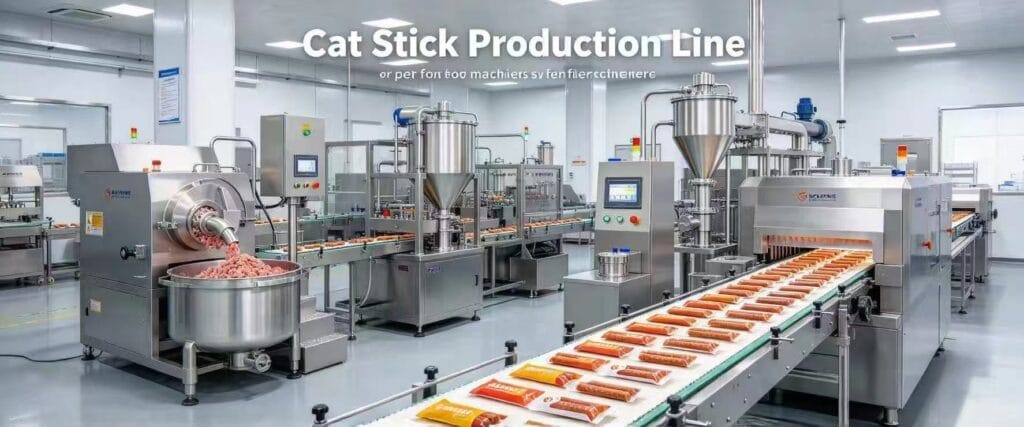
A typical cat stick production line comprises six stages:
Stage 1: Raw Material Preparation
Fresh or frozen meat — typically chicken, tuna, salmon, or a blend — is ground to a fine particle size using an industrial grinder. For frozen raw materials, a no-thaw frozen meat processing line can eliminate the thawing step, reducing labor, energy consumption, and microbial risk. This is the first critical step in the cat stick production line.
The ground meat is then transferred to a mixing tank where it is combined with water, stabilizers, flavor enhancers, and functional ingredients. Precise ingredient dosing is critical — small variations in stabilizer content can dramatically affect final product viscosity.
Stage 2: Emulsification and Homogenization
The mixed slurry passes through a high-shear emulsifier or colloid mill to achieve a uniform, smooth texture. In the cat stick production line, the target particle size for cat stick paste is typically below 100 microns — fine enough to pass through the filling nozzle without clogging and smooth enough to create the creamy mouthfeel cats prefer.
Emulsification also serves a functional purpose: it creates a stable oil-in-water emulsion that prevents fat separation during storage and sterilization. Inadequate emulsification leads to oiling-out, water separation, and inconsistent texture — three of the most common quality complaints in cat stick products.
Stage 3: Filling and Sealing
This is the most technically demanding stage of the cat stick production line. The viscous paste must be accurately dosed into narrow tubular sachets at high speed, without air pockets, drips, or seal contamination.
Key equipment considerations:
Filling system: High-viscosity piston fillers with servo-driven dosing are standard. Volumetric accuracy of ±1% is achievable with proper calibration.
Sachet format: Pre-made pouches or form-fill-seal (FFS) configurations are both used. FFS offers lower packaging material cost; pre-made pouches offer higher production speed and more consistent seal quality.
Sealing: Heat sealing with precise temperature, pressure, and dwell time control. Seal integrity is critical — any weakness will cause leakage during retort sterilization.
Hygiene design: The filling zone should be designed for CIP (clean-in-place) cleaning, with smooth surfaces, no dead corners, and food-grade contact materials.
Stage 4: Sterilization
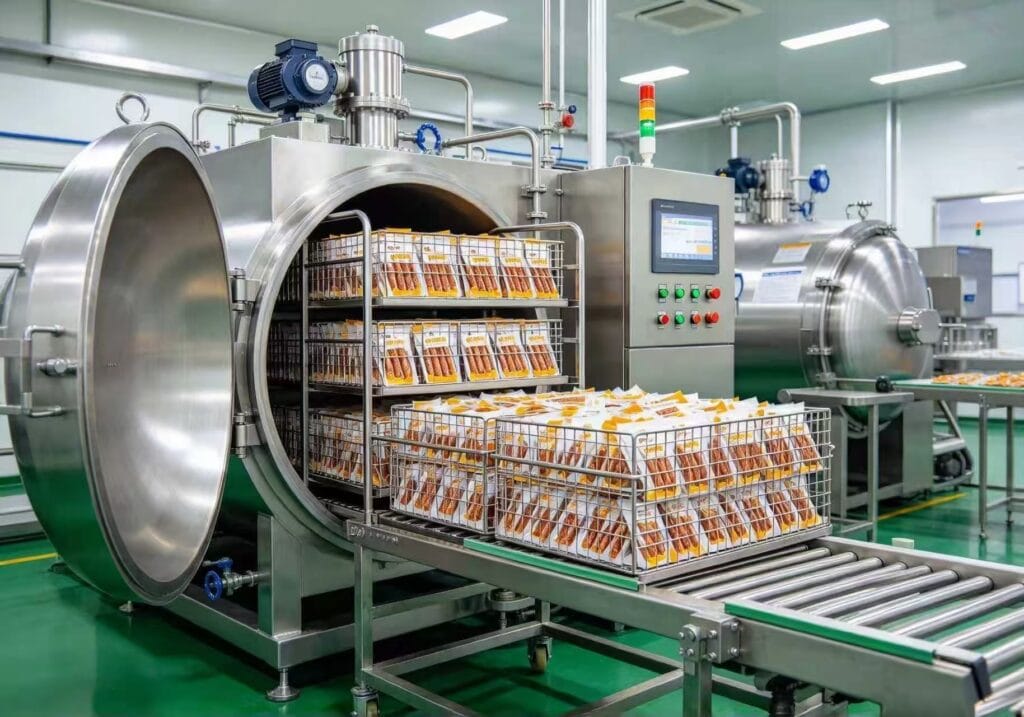
Filled and sealed cat sticks undergo retort sterilization to achieve commercial sterility and shelf stability at ambient temperature. In the cat stick production line, typical parameters are:
Parameter Typical Range Temperature 121°C Pressure 0.1–0.2 MPa Time 15–30 minutes (depending on sachet thickness and load) Cooling Gradual, with back-pressure to prevent sachet deformation Improper sterilization causes two common defects: under-processing (microbial risk) and over-processing (texture degradation, nutrient loss, off-flavors). Modern retort systems use programmable temperature profiles with multi-stage heating and cooling to optimize the balance.
Stage 5: Cooling and Drying
After sterilization, the cat stick production line cools the products in a controlled manner to prevent condensation and package deformation. Surface drying removes residual moisture from the sachet exterior, preparing the product for labeling and secondary packaging.
Stage 6: Labeling and Packaging
Finished cat sticks are labeled, date-coded, and packed into retail display boxes or multipacks. Automated systems can handle labeling, cartoning, and case packing as an integrated end-of-line solution for the cat stick production line.
Cat Stick Production Line Equipment Configuration by Production Scale
Scale Capacity Core Equipment Typical Investment Small 500–1,000 pcs/h Mixer, emulsifier, semi-auto filler, small retort $30,000–$60,000 Medium 2,000–5,000 pcs/h Mixing tank, colloid mill, automatic FFS filler, industrial retort $80,000–$180,000 Large 8,000–15,000 pcs/h Automatic batching, continuous emulsification, high-speed FFS, multi-basket retort, automated end-of-line $250,000–$500,000+ The filling and sealing equipment typically represents 35–45% of total cat stick production line investment, with sterilization accounting for another 20–30%.
Critical Quality Control Points for Cat Stick Production Line
Texture consistency: Viscosity must be controlled within a narrow range. Too thick and the product won’t dispense smoothly; too thin and it leaks from the sachet or separates during storage.
Seal integrity: Every sachet must pass seal strength testing. Common methods include burst testing, peel testing, and dye penetration testing. A leak rate above 0.5% is generally considered unacceptable for commercial production.
Sterilization validation: Each product formulation and package format requires validated sterilization parameters. Temperature distribution studies and heat penetration testing should be conducted before commercial production begins.
Water activity and pH: These two parameters determine the product’s shelf stability and microbiological safety. Most cat stick products rely on a combination of thermal sterilization and water activity control.
Market Trends Driving Cat Stick Demand
The cat stick format is expanding rapidly for several reasons:
Humanization of pets: Owners want to interact with their cats through feeding — squeezing a treat stick creates a bonding moment that traditional bowl feeding does not.
Convenience: No can opener, no spoon, no mess. The format is ideal for modern pet owners.
Portion control: Single-serve packaging prevents overfeeding and waste.
Functional formulation: The paste format is ideal for delivering supplements, hairball control ingredients, and probiotics.
E-commerce friendly: Lightweight, shelf-stable, and easy to ship.
These trends are driving strong demand for efficient cat stick production line equipment worldwide.
FAQ
Q: Can I produce both cat sticks and other wet pet food on the same cat stick production line?
A: Partially. The mixing, emulsifying, and sterilization equipment can often be shared. The filling and sealing equipment, however, is format-specific — a cat stick filler cannot produce cans or standard pouches without significant changeover and additional tooling.Q: What is the minimum viable production scale for a cat stick business?
A: A small-scale cat stick production line producing 500–1,000 pieces per hour can be a viable starting point for a regional brand or private-label operation. Below this scale, manual filling and small batch retorts are possible but labor-intensive and difficult to scale.Q: How long does it take to develop a cat stick formulation and validate the production process?
A: Expect 2–4 months for formulation development, including texture optimization and stability testing. Sterilization validation adds another 2–4 weeks. Working with an equipment supplier that provides process support can significantly shorten this timeline.Conclusion
Cat sticks represent a high-growth, high-margin opportunity in the wet pet food segment. The cat stick production line requires careful integration of mixing, emulsifying, filling, sealing, and sterilization equipment — each stage must be optimized for the unique demands of the high-viscosity, narrow-sachet format.
Planning a cat stick production line? Contact LongerFM for a customized equipment configuration and process support. From raw material preparation through end-of-line packaging, we provide integrated wet pet food solutions tailored to your target capacity and product format.
- Pet Food Machinery Trends
- Pet Food Processing Equipment Demand
- How to Choose the Right Meat Grinder for Pet Food Production