
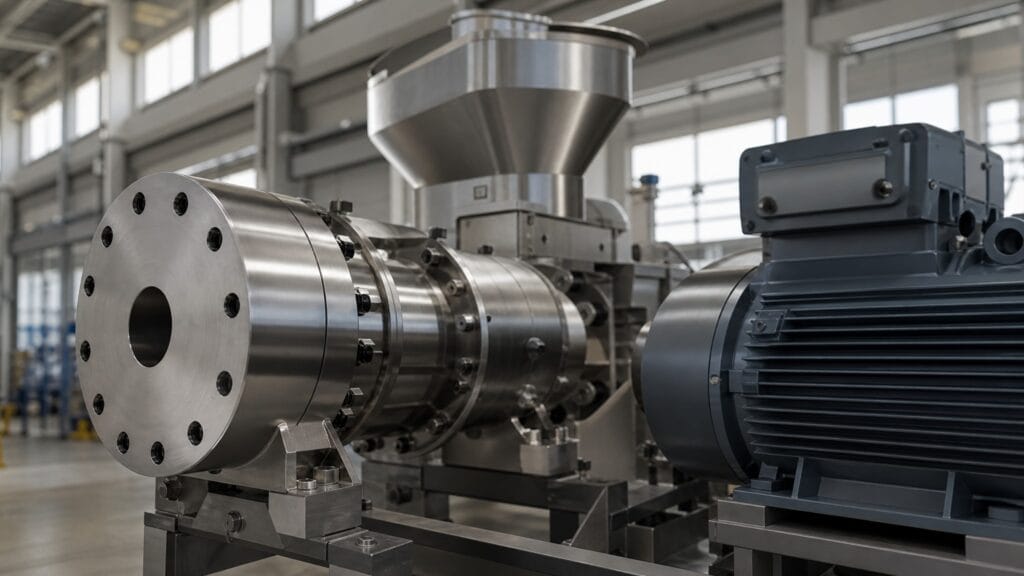
Procurement decisions for industrial pet food manufacturing need precise financial modeling, not generic catalog rates. The pet food extruder line price varies a lot based on engineering configuration, throughput targets, and the regulatory requirements specific to each facility. We put this breakdown together to help plant engineers and owners understand the actual cost drivers behind dry pet food production line cost estimates in 2026.
We can’t give accurate extrusion line pricing without first defining your throughput targets and automation level. Those two factors dictate motor sizing and control system complexity. So if a vendor quotes a fixed rate before assessing your process parameters, that number will likely move once technical validation starts.
Primary Cost Drivers for Pet Food Extruder Lines
The total investment for an extrusion system depends on three interconnected variables: output capacity, automation sophistication, and material construction standards. These elements drive the pet food extruder line price more than any single component spec or brand premium.
Define your target hourly output and desired automation level before requesting a turnkey pet food line quote. Skip that step and you risk an estimate that doesn’t account for downstream equipment scaling. A line built for 500 kg/h has fundamentally different mechanical and thermal requirements than one rated for 3,000 kg/h, right down to barrel diameter and dryer length.
Material grade also shapes both the upfront cost and how well the line holds up under compliance scrutiny. We design and manufacture all equipment in 304 stainless steel to meet international food safety standards. That keeps durability and compliance built in, rather than something you retrofit later. Lower-grade materials can cut the sticker price, but they raise the risk of failing FDA or CE audits, and replacing contact surfaces after installation is not cheap.
Capacity and Throughput Impact on Dry Pet Food Production Line Cost
Scaling production volume changes the dry pet food production line cost in non-linear ways, because larger capacities demand proportionally more thermal energy and mechanical drive power. Moving from small-batch processing to continuous industrial output means larger barrel diameters, higher-torque motors, and longer drying zones to hold product quality at speed.
Extruder specifications should match verified market demand, not a guess. Undersize the equipment and you force premature capital spending when demand grows. Oversize it and you lock capital into idle assets that eat floor space and energy without producing revenue.
Downstream equipment often ends up a bigger share of the total budget than the extruder itself once you scale up. Drying, cooling, and coating systems have to match the extruder’s maximum sustainable output, so a 20% jump in extrusion capacity might require a 30% increase in dryer surface area just to hold moisture specifications.
This mismatch between extruder rating and downstream capability is where many pet kibble production line cost estimates fall apart during implementation.
Automation Level and Labor Reduction in Extrusion Systems
Adding PLC controls, automatic dosing, and centralized monitoring raises the initial pet food extrusion machine price, but it cuts ongoing operational expense in measurable ways. Manual ingredient weighing, batch recording, and parameter adjustments need multiple operators per shift. Automated systems fold those tasks into a workflow one person can supervise.
Your facility’s labor cost structure decides whether advanced automation pays back within an acceptable timeframe. High-wage regions recover the investment faster than low-wage markets, though the gains in consistency and traceability apply regardless of wage levels.
Automation also shapes long-term ROI by cutting human error in recipe execution and enabling real-time process adjustments that manual operation can’t match. Consistent product density, moisture content, and coating application affect yield and customer acceptance directly, which makes precision control a revenue-protection measure as much as a labor-saving one.
We engineer control systems to balance the upfront investment against documented operational savings, rather than specifying maximum automation by default. That way you pay only for the level of integration your production environment and staffing model can actually use.
CE and FDA Compliance Factors in Turnkey Pet Food Line Quotes
Regulatory adherence is a non-negotiable cost component for export-ready equipment. It’s also why turnkey pet food line quotes vary so much: mandatory safety certifications and sanitary construction standards carry real cost. Meeting CE and FDA compliance standards requires specific welding protocols, surface finish specs, and documentation packages, and all of that adds manufacturing hours and inspection costs.
Since 2004 we have supplied medium to large manufacturers worldwide with CE and FDA certified machinery, building regulatory compliance directly into our base manufacturing process. That prevents the common scenario where equipment arrives at a facility and then needs expensive modification before it passes a local health inspection or clears customs.
Sanitary design goes beyond material choice. Crevice-free welds, self-draining surfaces, and accessible cleaning points all add fabrication complexity. None of that shows up on a basic spec sheet, but it becomes obvious fast during a third-party audit, or worse, after a contamination incident on a poorly built line.
Certification costs are fixed investments that protect market access, not optional upgrades. Facilities targeting regulated markets can’t treat compliance as a line item to negotiate away without risking shipment rejection or a facility shutdown.
Specialized Processing Technologies Beyond Standard Extrusion
Standard high-temperature extrusion differs fundamentally from premium processing methods, in both engineering requirements and resulting cost. Our automatic steamed pet food production line uses an independent low-temperature processing system, a different approach from traditional high-temperature extrusion that calls for specialized thermal engineering and distinct equipment architecture.
Choosing steaming or baking over standard extrusion raises capital cost, because of the added thermal management systems and longer residence times involved. Low-temperature methods preserve nutritional profile and texture in a way that commands premium pricing, but they also process fewer kilograms per hour per unit of installed equipment than conventional extrusion.
The low-temperature baked pet food production line combines cold-pressing with a gradual slow-bake process that needs precise temperature staging, something a standard extruder can’t offer. That complexity means more sensors, more heating zones, and more control loops, which raises both purchase price and maintenance needs.
Specialized thermal processing doesn’t suit facilities producing only commodity kibble at maximum throughput. It serves specific market segments, where product differentiation justifies the extra capital and operational complexity.
For manufacturers weighing multiple processing approaches, reviewing complete production line solutions gives the comparative context needed to judge which technology fits both product strategy and budget.
Turnkey Integration Versus Standalone Machine Pricing
Buying isolated units looks cheaper at first, but it often leads to a higher total cost of ownership once integration gaps, compatibility issues, and uncoordinated commissioning show up. A complete integrated system, mixers, extruders, dryers, coolers, and coating drums together, arrives pre-engineered to function as one process rather than a pile of separate machines.
Turnkey solutions cut hidden installation costs because the mechanical interfaces, electrical connections, and control logic are validated before shipment. Source components separately, and the burden of proving they work together falls entirely on your engineering team, eating internal resources and stretching out time-to-production.
Line-wide efficiency only happens when every subsystem is designed together from the start. An extruder running at peak efficiency feeds a dryer that holds consistent moisture removal, which lets a coater apply uniform coverage. Break that chain anywhere and overall line effectiveness drops, no matter how good the individual machines are.
Standalone machine pricing leaves out the engineering integration work that actually makes a production line produce. That’s exactly where budget surprises creep in during installation, once adapters, transition chutes, and control interface changes turn out to be necessary.
Requesting an Accurate Pet Kibble Production Line Cost Estimate
Precise quotations need technical data that defines your production environment and commercial goals. A generic inquiry gets a generic response. Detailed specifications get you an engineered proposal that reflects the actual cost of building your line.
Prepare your recipe formulations, target hourly capacity, floor space dimensions, utility specifications, and desired automation level before you request a quote. These parameters let us size equipment correctly and catch facility constraints early, before they turn into change orders during installation.
Ceiling height, column spacing, and existing utility locations all shape line layout, and therefore total project cost. Share architectural drawings early. That alone prevents us from proposing a configuration that simply can’t fit or connect inside your building.
Commercial proposals built on complete technical data skip the estimation buffers vendors add when information is thin. Submit detailed specifications through our portal, and we can request a customized quote that reflects your actual requirements instead of industry averages.
This level of detail is what separates a serious procurement inquiry from preliminary research, and it’s what gets you from first contact to an actionable commercial proposal faster.
Frequently Asked Questions
What information do I need to get an accurate pet food extruder line price?
You must provide target hourly capacity, recipe formulations, desired automation level, available floor space dimensions, and utility specifications. Without these parameters, vendors can only offer rough estimates that typically change significantly during technical validation. Detailed specifications enable engineered proposals that reflect actual implementation costs rather than industry averages.
How much does automation add to extrusion equipment cost versus manual operation?
Automation increases initial equipment cost through PLC systems, sensors, and integrated controls but reduces ongoing labor expenses and improves product consistency. The payback period depends on your local wage structure and production volume, with high-wage regions justifying comprehensive automation faster. We engineer control systems to match your specific operational needs rather than specifying maximum automation by default.
Why do CE and FDA certified lines cost more than non-certified equipment?
Certification requires 304 stainless steel construction, sanitary welding protocols, specific surface finishes, and comprehensive documentation packages that add manufacturing hours and inspection costs. These requirements are non-negotiable for export-ready equipment targeting regulated markets. Since 2004, we have integrated compliance directly into our base manufacturing process to prevent costly post-installation modifications.
Is specialized processing like steaming or baking worth the additional cost?
Specialized processing commands premium product pricing but requires additional capital investment and has lower throughput than standard extrusion. These technologies suit manufacturers targeting specific market segments where nutritional preservation and texture differentiation justify the complexity. They do not suit facilities producing only commodity kibble at maximum throughput.