

Most spec sheets for meat cutting machines are written around dicing. Strip and fillet slicing gets a line or two, and buyers end up comparing numbers that were never measured the same way.
We build both kinds of machine at LongerFM, so we know where the comparison breaks down. This guide covers what to check when you buy a frozen meat slicer for fresh meat strips: input state, blade and channel design, kg/h ratings, thickness tolerance, line position and hygiene. It is written for plant engineers and procurement teams who are buying a line stage, not a single machine.
1. Frozen or Fresh Input: Define the Cut Before You Compare Specs
Strip and fillet slicing produces thin, layered or lengthwise cuts from boneless meat. Dicing produces cubes. The two jobs use different blade arrangements, and they run at different product temperatures.
Input temperature is therefore your first filter. Our fresh meat slicer takes boneless fresh meat. Our frozen-meat dicers take blocks: the 2D Frozen Meat Dicer handles -18°C blocks with no thawing, and the Frozen Meat 3D Dicer works on meat between -10°C and 0°C.
If your raw material arrives as frozen blocks and your product is a cube, you are on the dicing route, and our frozen meat dicing machine buyer spec guide covers that side in detail. If your product is a strip, a fillet or a thin layer, read on.
A slicer is not a substitute for a dicer. It does not cut cubes, and it does not take frozen blocks.
2. Which Machine Covers Each Fresh Meat Strip, Fillet or Dice Job
The table below sorts our seven machines by input state, cut format and role in the line. Find your cut first, then check whether the input state matches what you actually have on the dock.
| Machine | Input state | Cut format | Line role |
|---|---|---|---|
| Dual Channel Fresh Meat Slicer | Boneless fresh meat | Horizontal layered cuts, adjustable thickness | Slicing stage |
| Fresh Meat Shaping Machine (Automatic Chicken Strip Forming Machine) | Fresh meat | Strip forming | Forming stage |
| 2D Frozen Meat Dicer | -18°C blocks, no thawing | Cubes: horizontal blades plus servo vertical cutting | Cube route |
| Frozen Meat 3D Dicer | 800-3000kg/h | Longerfm | -10°C to 0°C frozen meat | Cubes: 3D one-step cutting | Cube route |
| Frozen Meat Preprocessing Line | 5000-8000kg/h No-Thaw | Bulk frozen and frozen bone-meat | Preprocessing, not a final cut | Upstream stage |
| Fresh Meat Dried Slice Production Line (Low‑Temperature Dried Meat Pet Treats) | Fresh meat | Dried slices for pet treats | Separate fresh-meat route |
| Multifunctional Food Dicer (LNQD series) | Confirmed at quotation | Dicing | Cube route |
Seven machines cover slicing, strip forming, dicing, upstream preprocessing and dried pet-treat production. The right match depends on three things: the cut, the input temperature and your throughput target.
3. Blade Type and Channel Design for Fresh Meat Strip Cutting
Blade geometry is the main variable that sets the cut format. Channel count decides how many layers one pass produces. Both are worth reading before you look at any motor rating.
Blade Geometry for Fillet and Strip Cuts
The Dual Channel Fresh Meat Slicer cuts horizontally, in layers, across ultra-smooth flat cutting surfaces. The meat stays flat and the blade runs parallel to the belt, so you get a thin layer rather than a block.
The 2D Frozen Meat Dicer shows the contrast clearly. It pairs horizontal cutting blades with servo vertical cutting, so every pass produces cross-cuts as well as layers. That second cutting direction is what turns a slice into a cube.
When you read a competitor’s data sheet, look for that difference. A machine with only horizontal cutting makes layers. A machine with a vertical cutting axis makes dice, whatever the brochure calls it.
Dual Channel Meat Slicer Layout and One-Pass Cutting
The second channel gives the slicer synchronous multi-layer output in a single pass. Two channels running together mean more meat sliced per pass without running the feed faster, which helps when product quality limits how hard you can push the feed.
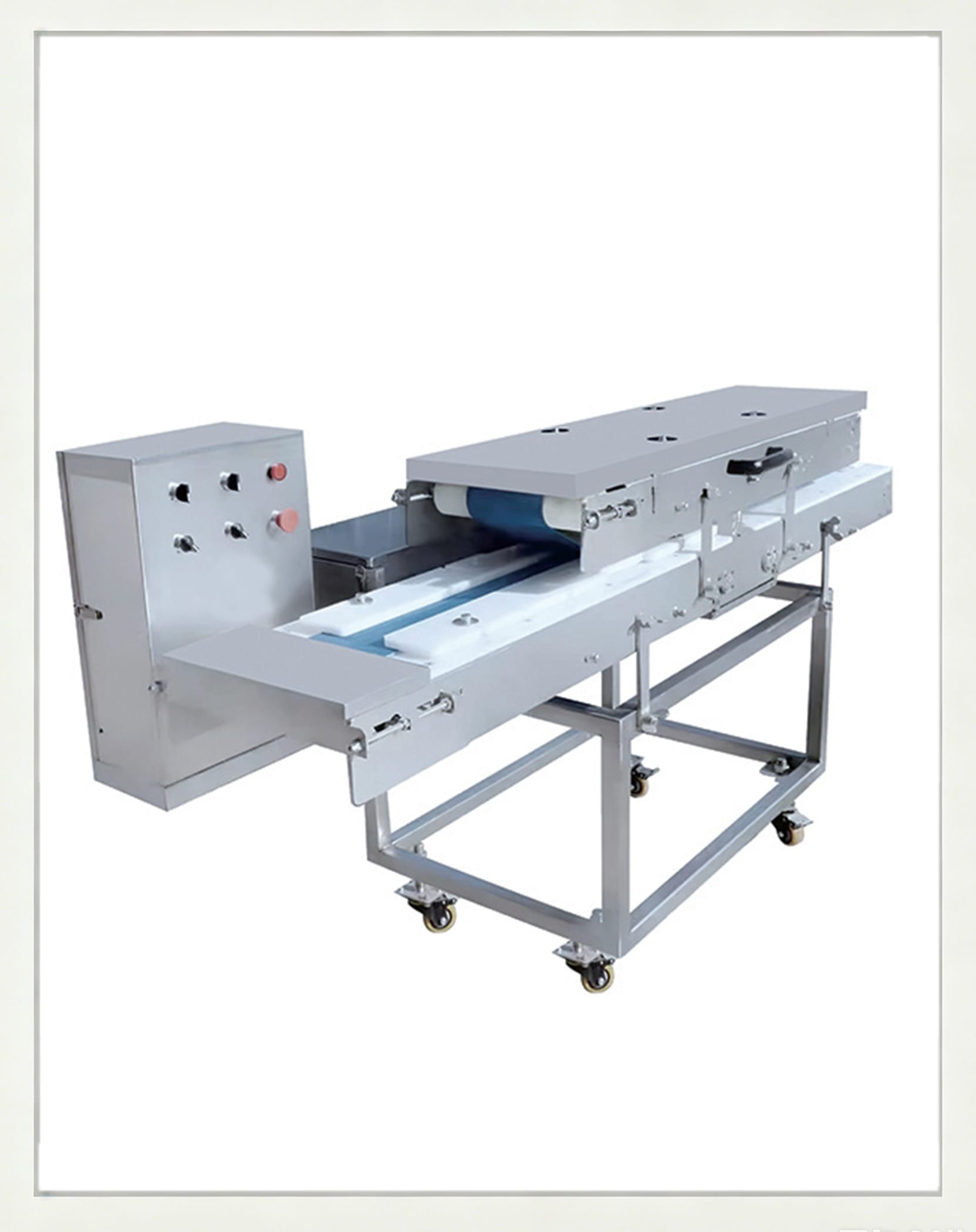
It also changes setup and wash-down. You are setting thickness for more than one layer, and you have more surfaces to open and rinse at the end of a shift. Plan the cleaning time into your cycle, and do not assume it matches a single-channel machine.
Put these questions to every supplier, including us:
- What material are the blades made from?
- How long does a blade change take, and who can do it on your crew?
- Do the blades and channels come apart for cleaning, and with or without tools?
4. Meat Strip Slicing Throughput: How to Read the kg/h Rating
A kg/h number is easy to print and hard to compare. Two suppliers can quote the same figure for very different jobs.
What a kg/h Figure Assumes
A rating compares fairly only when four things are stated: the cut size, the product temperature, the layers per pass and the basis of the rating. Without those four, a figure tells you nothing about your product.
So ask every supplier for the figure at your own cut size and your own meat temperature. Then convert it into operator hours per batch. A 6,000 kg batch at 1,000 kg/h takes six running hours, while the same batch at 750 kg/h takes eight, and that gap is a shift of labor.
A multi-layer, one-pass slicer behaves differently from a single-layer one. Its output depends on layer count and cut format, not only on feed rate. We do not publish a single slicer kg/h figure in this guide for that reason, and we quote it against your specification instead.
Reference Ratings for Dicing and Preprocessing Stages
LongerFM lists the Frozen Meat 3D Dicer at 800-3000 kg/h and the Frozen Meat Preprocessing Line at 5000-8000 kg/h (No-Thaw). Read them by stage, not as rivals.
The dicer cuts frozen meat between -10°C and 0°C into cubes. The preprocessing line sits upstream and handles bulk frozen and frozen bone-meat raw material at a much higher rate. One line feeding a slower downstream machine is normal, as long as you buffer between them.
These two ratings are not slicer ratings. Do not use them to size a strip or fillet stage.
5. Slice Thickness Tolerance and How to Verify It
Tolerance is the allowed spread around a set thickness. A setting of 10 mm with a tolerance written in the quotation means every strip should land inside that band, and a strip outside it is a reject.
The Dual Channel Fresh Meat Slicer has adjustable cutting thickness, so you set the target on the machine. What the machine holds across a shift is a separate question, and only a measurement answers it. We publish no tolerance figure in this guide, because the figure that counts is the one written into your quotation.
Setting Thickness and Running a Sample Check
Verify the claim at the line’s own meat temperature, because meat firmness changes how it cuts. A strip cut from cold meat and one from warmer meat will not measure the same.
- Set the thickness and run the machine until the product temperature is stable.
- Take strips at the start, the middle and the end of the run.
- Measure each strip and note the highest and lowest values.
- Compare that spread with the tolerance in the quotation.
If the spread widens toward the end of the run, ask about blade condition and feed consistency before you accept the machine. You should agree on this test and its pass criteria before you sign, not at commissioning.
6. Where a Meat Preprocessing Slicer Fits in the Line
A slicer rarely works alone. It depends on what arrives from upstream and on what the next station expects.
Here is the flow we plan around:
- Frozen intake
- Frozen Meat Preprocessing Line | 5000-8000kg/h No-Thaw
- Boneless meat at the set temperature
- Dual Channel Fresh Meat Slicer, or the Fresh Meat Shaping Machine (Automatic Chicken Strip Forming Machine), depending on the product
Frozen blocks take a separate route. They go straight to a 2D Frozen Meat Dicer at -18°C or a Frozen Meat 3D Dicer at -10°C to 0°C, chosen by block temperature.
Upstream: No-Thaw Preprocessing Before the Slicer
The first handoff to check is the one between preprocessing and slicing. Temperature and boneless state must both match what the slicer is rated for.
Confirm with us which upstream stage delivers your boneless meat, because the slicer takes boneless input only. Bone-in material needs to be dealt with before it reaches the slicing stage. We design full turnkey lines as well as standalone machines, so we can specify these handoffs as one system. Our note on choosing the right line stage helps when you are weighing what belongs where.
Downstream: Strip Forming and Dried-Slice Routes
After slicing, a product that needs a defined strip shape goes to the strip forming machine, also known as the automatic chicken strip forming machine. That is the route for formed chicken strips.
The Fresh Meat Dried Slice Production Line (Low‑Temperature Dried Meat Pet Treats) is a different thing. It is a separate fresh-meat route for original-cut pure-meat pet treats, and it is not a reconstituted frozen-meat process. Do not treat it as a downstream add-on to the frozen preprocessing flow.
7. Hygiene, Cleaning and Certification Checks
Hygiene starts with construction. The Frozen Meat 3D Dicer is one integral body made of food-grade SUS304 stainless steel, with no sanitary dead corners. The 2D Frozen Meat Dicer uses a brushed food-grade 304 stainless steel frame. LongerFM equipment is built from 304 stainless steel throughout.
Stainless Construction and Cleanable Surfaces
Stainless contact surfaces are the minimum. What matters on the floor is access: can your sanitation crew reach the blades and channels, and how long does it take?
Ask how blades and channels come apart for daily wash-down, and ask to see it. A machine that needs a half-hour teardown will be cleaned less thoroughly than one that opens in minutes.
Our equipment carries CE and FDA certification. Match the certificates to the exact model in your quotation, because a certificate for one machine in a range does not automatically cover another. We supply the documentation for the model we quote, and you should check it against the quoted title before you place an order.
If you want a slicer matched to your line, request a quote through our Contact Us page. Send us your cut type, input temperature, target kg/h, thickness tolerance and line position, plus the commissioning and operator training scope you expect, and we will match a model and quote it.
Frequently asked questions
Can one machine both slice strips and dice cubes?
No. The Dual Channel Fresh Meat Slicer cuts horizontal layers from boneless fresh meat. Cubes need a vertical cutting axis, which is what the 2D Frozen Meat Dicer adds with its servo vertical cutting. Pick the machine by the cut you need.
Do I need to thaw meat before it goes into the slicer?
The slicer is built for boneless fresh meat. Frozen blocks go to a dicer instead: the 2D Frozen Meat Dicer takes -18°C blocks with no thawing, and the Frozen Meat 3D Dicer takes meat between -10°C and 0°C. Tell us your product temperature and we will confirm the route.
What kg/h should I ask a supplier to quote for a strip slicer?
Ask for the figure at your own cut size and product temperature, with the number of layers per pass and the rating basis stated. A figure without those four details cannot be compared with another supplier’s. Then convert it into operator hours per batch.
How do I check that slice thickness stays within tolerance?
Take strips from the start, middle and end of a run at your line’s meat temperature, then measure them. Compare the spread with the tolerance written into the quotation. Agree this test before you sign.
Which certificates should I ask for?
Ask for the CE and FDA documentation for the exact model in your quotation. Our equipment is built from 304 stainless steel with CE and FDA certification, and the paperwork should match the quoted machine title.