
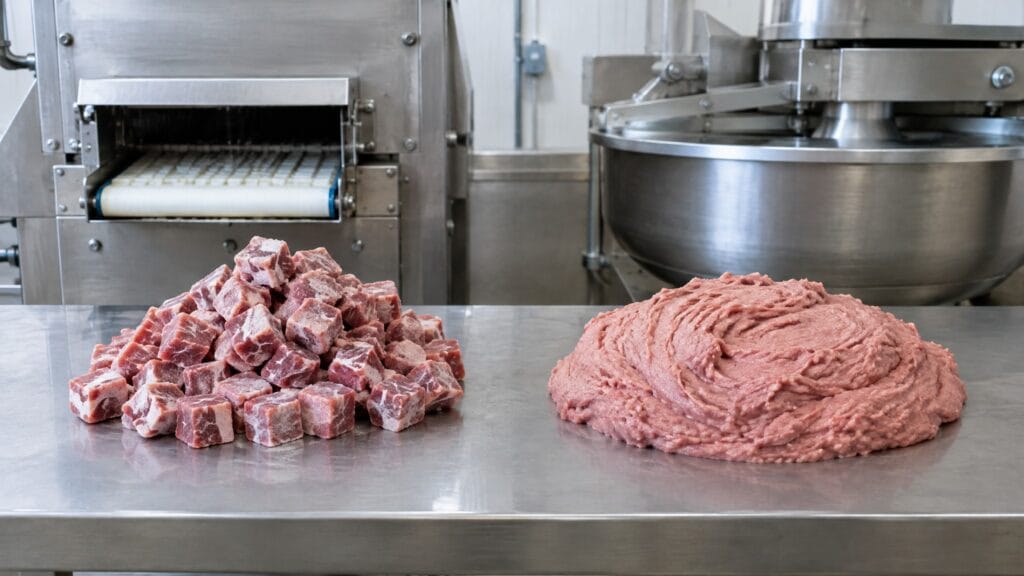
Choose by the shape of the finished product. If it is made of discrete cubes, you need a frozen meat dicing machine. If it is a fine chop or an emulsion, you need a bowl chopper.
That single rule settles most of the comparison, and the rest of this article works through its consequences for pet food, meat products, throughput and procurement. We have designed and built meat and pet food processing machinery since 2004, and we supply both machine types as standalone units or as part of a turnkey line. Both are built from 304 stainless steel and carry CE and FDA certification.
1. Dice Size vs Chop Texture in Frozen Meat Dicing and Bowl Chopping
A dicer cuts meat into pieces you can still see and count. A bowl chopper breaks the meat down until individual pieces disappear into a paste or batter. These are different products, not two settings on the same machine, so the decision belongs at the start of the project rather than at commissioning.
2D Frozen Meat Dicer: Cubes from Unthawed Blocks
Our 2D Frozen Meat Dicer was developed in-house to dice raw -18°C frozen meat blocks with no thawing step. Horizontal cutting blades make the first cut, and servo-driven vertical cutting finishes the cube. The frame is brushed food-grade 304 stainless steel.

Dicing output sits in the 5–25 mm band. Within that band you set the cube size to suit the recipe, from small inclusions to large visible chunks. Blade configuration, capacity and fitting details belong in our dicing machine buyer spec guide, which we wrote for buyers who have already settled on dicing.
Vacuum Bowl Chopping: Fine Texture, No Return to Cubes
The ZB Series variable frequency vacuum bowl cutter is independently developed for industrial fine chopping and emulsification. It is offered in 40, 125 and 200 models, and it works under vacuum with variable frequency drive control.
The limit is built into the process, because a chopped batch cannot be cut back into cubes. Diced pieces can always be chopped finer later, but the reverse is impossible. So if there is any chance your product range will need visible pieces, dicing keeps that option open and chopping closes it.
Side-by-side
| Factor | 2D Frozen Meat Dicer | ZB Series Vacuum Bowl Cutter |
|---|---|---|
| Output | Discrete cubes, 5–25 mm | Fine chop or emulsion |
| Typical input | Unthawed -18°C blocks | Meat already reduced in size |
| Can output be reworked? | Cubes can be chopped further | Cannot be cut back into cubes |
| Pet food use | Chunks with visible muscle pieces | Restructured chunks from heat-set emulsion |
| Meat product use | Diced inclusions in cooked products | Emulsified batters |
| Output logic | Falls as cube size shrinks | Batch mass divided by cycle time |
2. Choosing a Pet Food Chunk Cutting Machine: Natural Cubes or Emulsion Chunks
A pet food chunk cutting machine is only the right choice once the recipe is fixed. Visible muscle pieces in gravy or jelly point to dicing. A uniform restructured chunk made from a heat-set meat emulsion points to bowl chopping, and you should confirm which of the two your brand promises on the pack before you specify either one.
Diced Frozen Meat for Chunks with Visible Pieces
The route is short: frozen blocks → 2D Frozen Meat Dicer → chunk assembly.
Take a typical case. One frozen block goes through the dicer and comes out as discrete cubes, which are portioned into chunks for a wet recipe. Each cube keeps its grain and muscle structure, so the consumer sees real meat in the tray or pouch.
This route suits a 2D Frozen Meat Dicer well, because the meat enters at -18°C and never needs a thawing stage that would add drip loss and floor space.
Vacuum Bowl Cutter Emulsion for Restructured Chunks
The emulsion route has more stages: pre-reduced meat → ZB Series Variable Frequency Vacuum Bowl Cutter (40/125/200 Models) → heat-set → cut chunks.
Here the same meat, reduced first and then run through the bowl cutter, leaves a fine emulsion. That emulsion must be heat-set before it can be cut into chunks. A vacuum bowl cutter emulsion gives you control over texture and shape, but it gives you no visible muscle fibre.
The two outputs cannot be swapped without changing the recipe.
For the wider picture of how these stages fit a wet food plant, read our guide to selecting equipment for a wet pet food line. We do not repeat the line detail here.
3. Meat Product Applications: Emulsified Batters and Diced Inclusions
Meat product lines split the same way. Emulsified batters for sausage-type products run through the ZB Series Variable Frequency Vacuum Bowl Cutter, where vacuum limits air entrapment in the batter. Cooked products with diced inclusions get their pieces from the 2D Frozen Meat Dicer.
Some recipes need both. A batter carrying visible cubes uses the bowl cutter for the matrix and the dicer for the inclusions, and the two streams meet after cutting. If your plant makes more than one product family, you may well end up specifying both machines on one line.
Vacuum Mixing After the Cutting Step
Blending comes after cutting, not instead of it. We place the 30l-500l Vacuum Meat Mixer downstream of the cutting stage to blend the cut components, and we describe it only within its listed 30–500 L range.
A mixer does not change particle size in any way you should plan around. It will not turn cubes into batter or batter into cubes, so the cutting decision still has to be made first.
4. Throughput: Continuous Dicing vs Batch Chopping
A dicer and a bowl chopper do not produce kilograms per hour in the same way, which is why comparing them machine to machine misleads. We compare at line level instead. Our Frozen Meat Preprocessing Connected Production Line is listed at 5000–8000 kg/h for bulk frozen and frozen bone-meat raw materials, and that figure is the feed your cutting stage has to match.
A dicer runs continuously. At a fixed cut speed, output falls as cube size shrinks, because a smaller cube means more cuts per kilogram. So a 5 mm cube will move fewer kilograms per hour than a 25 mm cube on the same machine at the same speed.
A bowl chopper runs in batches. Its output equals batch mass divided by cycle time, and the cycle has three parts: fill, chop and discharge. You can raise output by shortening any of the three or by running a larger model, but you cannot make a batch process continuous.
For budgeting the bowl chopper side, we cover the main vacuum bowl chopper cost drivers separately, so we quote no prices here.
Upstream Preprocessing Sets the Feed Ceiling
The Frozen Meat Preprocessing Connected Production Line is a fully automated system, and neither a dicer nor a bowl chopper can outrun what it delivers. If the upstream stage supplies a given kg/h of broken, conveyed meat, that figure is the ceiling for everything after it.
Size the cutting stage to that ceiling, not to a nameplate maximum. A cutter that can process more than the line feeds it simply idles, and one that cannot keep up becomes the bottleneck you pay labor to work around.
5. Selection Criteria for a Frozen Meat Dicing Machine or Bowl Chopper
We recommend deciding in a fixed order, because each step narrows the next.
- Output form. Cubes in the 5–25 mm band, or a fine chop or emulsion.
- Input form. Unthawed frozen blocks, or meat already reduced in size.
- Throughput basis. Continuous kg/h for dicing, or batch mass over cycle time for chopping.
- Sanitation and certification. Stainless construction, CE and FDA.
- Line integration. How the machine connects to the Frozen Meat Preprocessing Connected Production Line.
If you change the order and start from price or footprint, you risk buying a machine that cannot make your product.
Input Form: Frozen Blocks or Pre-Reduced Meat
The 2D Frozen Meat Dicer takes unthawed -18°C blocks directly. A bowl chopper usually takes meat that has already been reduced in size, so block breaking sits upstream of it. That upstream stage either exists in your plant or has to be added to the budget.
Where that stage belongs, and whether a grinder or a bowl cutter is the right tool at a given point, is covered in our piece on which line stage needs a bowl cutter.
Certification, Stainless Construction and Line Integration
Our equipment is CE and FDA certified, and we build it in 304 stainless steel. The 2D Frozen Meat Dicer uses a brushed food-grade 304 frame, and the ZB Series bowl cutter is built for industrial food processing. Your auditors will ask for the certification documents, so request them for the exact configuration you are buying.
Certification does not replace a line-level check. A certified machine still has to connect to your conveyors, infeed and discharge points, and that is why we specify the whole line rather than single machines.
6. Other Lines Outside the Dice-or-Chop Decision
Three of our lines handle raw material in their own way, so they are separate routes rather than substitutes for a dicer or bowl chopper.
- Pet Enzymatic Hydrolysis Meat Production Line. Built for fresh meat, frozen meat, poultry and livestock offal.
- Fresh Meat Dried Slice Production Line (Low-Temperature Dried Meat Pet Treats). Built for fresh meat rather than reconstituted frozen meat.
- Pet Meat Chip Production Line (Composite Meat Slice & Meat Jerky Snack). A low-temperature baking line for thin-sheet composite meat snacks.
Each sets its own raw-material handling. If your product is one of these, check that line’s specification before assuming you need a dicer or bowl chopper in front of it.
7. Next Step: Send Us Your Output Spec for a Line Recommendation
We recommend a 2D Frozen Meat Dicer, a ZB Series Variable Frequency Vacuum Bowl Cutter, or both, based on what you need to make. To give you a line-fit recommendation, we need the following:
- Target cube size or chop texture
- Product type: pet food or meat product
- Required kg/h
- Frozen block size and temperature
- The existing line stage the machine must connect to
Send us your output spec through the contact page, and our engineers will come back with a recommendation matched to your line.
Frequently asked questions
Can a bowl chopper make cubes?
No. A bowl chopper produces a fine chop or emulsion, and a chopped batch cannot be cut back into cubes. If you need discrete pieces in the 5–25 mm band, the cutting step has to be a dicer such as our 2D Frozen Meat Dicer.
Do I need to thaw frozen meat before dicing it?
Not for our 2D Frozen Meat Dicer, which takes raw -18°C blocks directly without any thawing treatment. A bowl chopper is different: it usually takes meat already reduced in size, so block breaking happens upstream of it.
Which machine do I need for pet food chunks with visible meat pieces?
Use a dicer. Chunks made from diced frozen meat show distinct muscle pieces. Restructured chunks come from a heat-set meat emulsion made in a vacuum bowl cutter, and they look uniform.
Can one line use both a dicer and a bowl cutter?
Yes. Some recipes pair an emulsified batter with diced inclusions, so the bowl cutter makes the batter and the dicer makes the cubes. The two streams meet after cutting, for example at a vacuum mixer in the 30–500 L range.
How do I compare dicer and bowl chopper capacity?
Compare at line level in kg/h. A dicer runs continuously, and its output falls as cube size shrinks at a fixed cut speed. A bowl chopper’s output equals batch mass divided by cycle time, which covers fill, chop and discharge.