

Bone Processing Line – Turnkey Solution for Cattle, Sheep, Pig & Fish Bones
This Bone Processing Line is specifically designed for the continuous pre-treatment of cattle, sheep, pig, fish, and various livestock and aquatic bones. The entire line follows a streamlined process: “Washing → Elevating & Spraying → Primary Crushing → Secondary Crushing → Fine Milling.” It integrates standalone machines into a closed, continuous, and centrally controllable pre-treatment assembly line.
Sharing the same modular design philosophy as our Frozen Meat Pretreatment Line, it is widely applicable to pet wet food/canning factories, bone broth and bone paste sauce plants, deep-processed meat enterprises, and large slaughtering and deboning workshops.
1. Line Configuration & Process Connection
Standard Line Configuration:
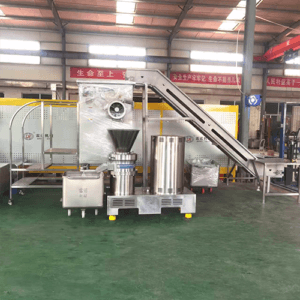
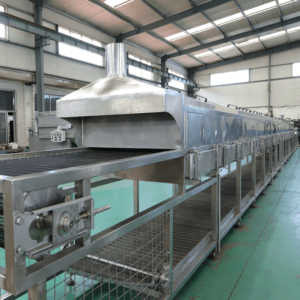
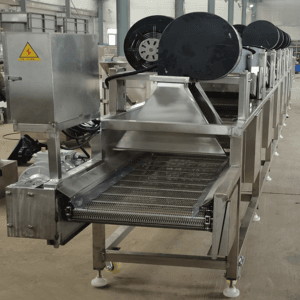
Process Logic: Raw bones first enter the washing tank to remove surface blood, impurities, and attached soft tissues. Subsequently, the chain-plate elevator transports the materials while subjecting them to spray washing for secondary cleaning before automatically feeding them into the primary crushing station.
The first industrial bone crusher handles the primary crushing task, breaking large bone blocks into particles suitable for secondary crushing. The second industrial bone crusher performs secondary crushing, further reducing the bone particles to a size range that allows the bone paste mill to grind efficiently. Finally, the GN Series Bone Paste Mill completes the ultra-fine grinding and emulsification, discharging a fine paste/bone mud state that directly connects to downstream boiling, sauce blending, or pet wet food filling processes.
Note: The reason for using two crushers in series rather than a single “one-step” unit is that if a single crusher is pushed to achieve extremely fine output, its capacity drops significantly, and blade wear accelerates. By separating primary and secondary crushing, each machine operates within its optimal efficiency range, ensuring both line stability and uniform bone particle size. The downstream bone paste mill has specific requirements for input particle size (typically recommended at the size of a mung bean or soybean), which is exactly why the secondary crushing stage is configured.
2. Core Equipment Introduction
PG Series Industrial Bone Crusher (Primary Station)
The PG Series Industrial Bone Crusher features a cutter frame with optimized force distribution, delivering strong shearing and impact capabilities to quickly process hard or large bones such as cattle, sheep, pig, and fish bones. The precisely adjusted cutter angle ensures uniform discharge particles without extrusion agglomeration, providing a stable material source for downstream secondary crushing or bone paste milling.
The equipment is equipped with motor overload protection and hopper interlock power-off, automatically stopping when the hopper is opened or material blockage occurs. The SUS304 stainless steel contact parts support linkage with the conveyor line for automatic feeding and discharging.
Selection Reference: Based on the incoming material size and target capacity, models ranging from PG-400 to PG-800 are available. If the raw materials are primarily large cattle and sheep bones, starting from PG-500 or above is recommended. If processing mainly pig bones, poultry frames, or fish bones, PG-400 can meet most medium-capacity scenarios.
PG Series Industrial Bone Crusher (Secondary Station)
The secondary crusher further reduces the bone particle size based on the primary crushing, providing fine bone particles that meet the input requirements of the bone paste mill. Compared to the primary model, this station can be equipped with smaller discharge screens or adjusted cutter configurations based on the primary output size, ensuring finer and more concentrated bone particles while maintaining capacity. It also features overload protection and hopper interlock, with maintenance methods identical to the primary crusher, and the blades can be repeatedly sharpened.
GN Series Bone Paste Mill
The GN Series Bone Paste Mill is the core fine-processing equipment of the entire line. It integrates homogenizing, ball milling, shearing, and mixing functions to grind the finely crushed bone particles into ultra-fine bone paste of 2–50 microns, with a homogeneity of over 90%. The equipment adopts heat-treated high-hardness rotors and stators, supporting the fine grinding of chicken bones, duck bones, fish bones, pig bones, cattle and sheep bones, etc.
The output is delicate without a grainy texture while retaining the natural calcium nutrition in the bones. The GN series offers multiple models from GN-110 to GN-300, with capacities ranging from 150–200 kg/h to 3000–4000 kg/h, flexibly matching the upstream crushing stations.
3. Core Line Advantages
- Two-Stage Crushing + Fine Grinding for Controllable Fineness and Stable Capacity: The division of labor between primary and secondary crushing avoids the conflict of “sacrificing capacity for fineness” in a single machine. The bone paste mill operates at the optimal input particle size, ensuring both grinding efficiency and consistency in finished product fineness.
- Tandem Washing & Spraying for Front-End Hygiene: The washing tank removes a large amount of surface impurities, and the spray washing during elevation completes the secondary cleaning, reducing the microbial load and impurity introduction in subsequent crushing and grinding stages.
- Fully Closed Connection to Reduce Manual Transfer: The stations are connected by elevators, conveyors, or pipelines, ensuring materials do not touch the ground. This reduces the risk of cross-contamination and minimizes the capacity constraints caused by manual handling.
- SUS304 Food-Grade Contact Material for Export & Audits: The material contact parts of the bone crushers and bone paste mill are made of food-grade stainless steel, which is detachable and washable with no dead corners. The entire line can be provided with export supporting certifications such as CE and FDA.
- Customizable Capacity with Flexible Standalone Use: The line capacity depends on the model combination of the bone crushers and the bone paste mill. Users can choose matching configurations based on their daily processing volume. Each standalone machine can also operate independently, facilitating phased production or future capacity expansion.
4. Technical Parameters (Line Reference Values)
| Parameter Item | Reference Specification |
|---|---|
| Applicable Raw Materials | Cattle, sheep, pig, fish, poultry bones, and various livestock/aquatic animal bones |
| Line Capacity Range | Approx. 500–4,000 kg/h (depending on the crusher and mill model combination) |
| Bone Crusher Stations | PG Series × 2 units (Primary + Secondary) |
| Bone Paste Mill Station | GN Series × 1 unit (Model matched to target fineness and capacity) |
| Bone Paste Fineness | 2–50 microns (Homogeneity ≥90%) |
| Material Contact Material | SUS304 Food-grade Stainless Steel |
| Line Control | Independent control for each machine, optional linkage start/stop and conveyor connection |
| Applicable Bone Temperature | Fresh bones, chilled bones, and partially unthawed frozen bones (subject to crusher model confirmation) |
Note: The above are reference configurations and parameter ranges for the connected production line. Actual capacity, power, footprint, and connection methods need to be customized based on the user’s raw material types, incoming sizes, target output fineness, and workshop layout.
5. Applicable Industries & Scenarios
- Pet Wet Food / Canning Factories: Cattle, sheep, chicken frames, and fish bones are processed into fine bone paste through the entire line, directly used for the pre-treatment of raw materials in wet food cans and meat-bone mixed formulas.
- Bone Broth / Bone Paste Sauce Factories: Primary crushing and fine grinding are completed continuously, providing uniform bone particles/bone paste for boiling pots or blending tanks, reducing boiling time and batch variations.
- Deep-Processed Meat Enterprises: Bone paste, as a calcium source or flavor raw material, is incorporated into the formula systems of sausages, meatballs, and prepared meat fillings. The entire line can be embedded into existing pre-treatment workshops.
- Large Slaughtering & Deboning Workshops / Bone By-product Processing Centers: Convert slaughtering by-product bones into semi-finished bone paste on-site, reducing outbound transportation costs and enhancing the added value of by-products.
6. Supporting Services & Contact
The execution standards of this connected production line refer to the relevant requirements of GB 16798-1997 “Safety and Hygiene Standards for Food Machinery”. Our factory holds EU CE machinery certification, US FDA factory registration, and multiple utility model patents. We provide complete line export documents, overseas on-site installation and commissioning, operation training, and long-term supply of original spare parts such as blades, screens, and rotor/stator sets.
If you need a dedicated Bone Processing Line solution matched to your raw material types (cattle/sheep/pig/fish bone ratio), daily processing volume, and target bone paste fineness, please contact our engineers for a free layout plan and detailed quotation.
Contact Us Now for a Customized Bone Processing Line Solution →


Reviews
There are no reviews yet.